
by Joseph Knelman
Trust is central to the basic function of society and essential to designing environments, communities, and products. Trust reduces the complexity and uncertainty of future economic and social interactions (Lewis and Weigert 1985) that users will face using an environment/product. Rather than discussion of overarching company values, or trust internal to social networks themselves (such as in reputation systems), here I explore elements of trust that may provide a lens for user experience design itself.
Types of Trust
Lewis and Weigert (1985) bring trust under the purview of sociology in their seminal work, describing several aspects of trust, which may help to guide designing trust into user experiences. First, trust may function both on emotional (faith) and cognitive (rational prediction) levels—design may account for either of these aspects of trust or any combination of the two (see figure, Lewis and Weigert 1985). Thus, user experience researchers and designers should seek to find moments in the customer journey that may require leaps based on trust, which may in turn impact user retention or task completion. Designers should consider what flavor of trust is needed for particular user outcomes. Where exactly do these integral moments of trust fall in the customer journey and in the emotional/cognitive trust landscape? What design elements may better address user needs to establish such trust? The story or experience that is constructed may take on different forms when considering trust in this light. Might it be pertinent to build emotional trust in an environment that is naturally suited to more rational trust? Consider companies like Patagonia and Apple, where product and experience design engender strong cognitive (repairs for life/genius bar-AppleCare) and emotional (commitment to protecting nature/coherent design aesthetic) trust. Such user experience that promote ideological trust can build a base of brand-devotees.
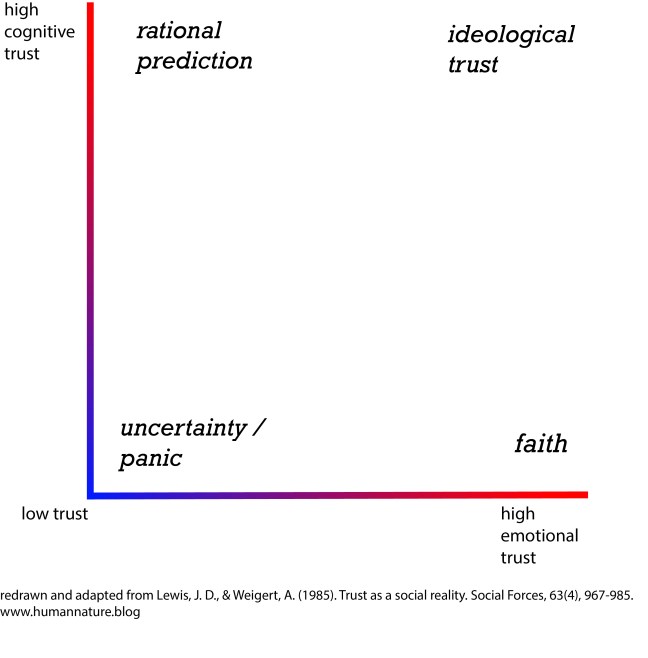 In addition, trust may act on an interpersonal or system level (Lewis and Weigert 1985). Interpersonal trust may be more prominent where personal trust is at stake and is related to close relationships of primary group interactions (and therefore stronger components of emotional trust), whereas system trust is typically accompanied by top-down rules and sanctions (Lewis and Weigert 1985). As such, designing for trust in user experiences may necessarily relate to system trust, but the visibility of such structure or the appearance of interpersonal trust may be a deliberate design consideration. For example, a social network where endorsements are portrayed as drawing on more involved interpersonal relationships and relate to the people themselves, the greater focus on emotional trust builds in an aspect of interpersonal trust to the system trust environment (e.g. LinkedIn). In contrast a reputation system that is more about the quality of a transaction directly highlights system trust for what it is and orients more around cognitive trust (e.g. Airbnb).
Measuring Trust
How might we better understand trust in some defined way to incorporate it into user experience design? Rempel’s trust scale (Rempel et al. 2004) a long-standing measure of trust, decomposes trust into three parts which can be considered in designing experiences.
- Predictability: “the consistency and stability of a partner’s specific behaviors, based on past experience.”
- Dependability: “the dispositional qualities of the partner, which warrant confidence in the face of risk and potential hurt (e.g., honesty, reliability, etc.)”
- Faith: “feelings of confidence in the relationship and the responsiveness and caring expected from the partner in the face of an uncertain future.”
(Rempel et al. 1985)
Do design decisions (such as improvements) that may sacrifice predictability in user experience warrant strong enough gains in dependability to preserve trust? How can an experience build faith by considering emotional trust over cognitive trust? In many cases unique iterations of product design may improve or sacrifice these different elements of trust.
In total, designing experiences may consider to what extent emotional/cognitive trust and interpersonal/system trust may be relevant and appropriate at various moments through the customer journey. If cognitive and emotional trust can both be reinforced via UX design, an ideological trust may be developed. Although most company built experiences will relate to system trust, the visibility of this system trust may be emphasized or deemphasized by design. An experience may be made to evoke feelings of interpersonal trust or it may reinforce system trust central to the function of the ecosystem. UX design should account for trust in a way that is consistent with the narrative of the product/experience, the needs of the user, and the values of the company.
Citations:
Lewis, J. D., & Weigert, A. (1985). Trust as a social reality. Social forces,63(4), 967-985.
Rempel, J. K., Holmes, J. G., & Zanna, M. P. (1985). Trust in close relationships. Journal of personality and social psychology, 49(1), 95.
 Verstehen